

According to the American Academy of Implant Dentistry (AAID), about 3 million people in the United States had dental implants in 2023. The AAID also suggests that this number is growing rapidly. One study predicts that between 6% and 23% of Americans will have dental implants by 2026. This staggering number reflects the growing trust people place in dental implants to replace their missing teeth! These titanium screws secure in your jawbone to serve as a foundation for dental restorations. Whether you’re missing one tooth or all of your teeth, dental implants are one of the most secure solutions around for tooth loss! However, there are different types of implants. When choosing between a mini implant vs. a regular implant, the decision depends on a number of factors, including your bone quality.
You’ll need to schedule a free implant consultation at Fine Dental Care to know which implant is right for your smile!
The Importance of Replacing Missing Teeth
Natural teeth have roots that lie beneath your gums, embedded in your jawbone. Not only do these roots keep your smile secure, but they’re also responsible for stimulating your jaw to keep it healthy. When you bite or chew, your tooth roots press into your jawbone. This pressure sends a signal to the bone that causes new bone to build while old material breaks down, keeping your jaw strong and healthy.
But when you lose teeth, you lose this stimulation, causing your jaw to weaken over time. As the jaw resorbs, losing mass and volume, patients experience issues like:
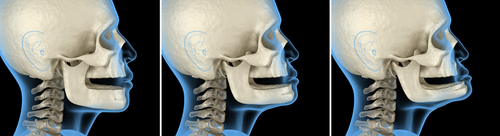
- Changes in face shape: When your jawbone shrinks, the shape of your jaw and face changes slowly. Often, patients find that their jaws resorb inward and upward, creating a noticeable difference in their appearance.
- Troubles with TMJ: The temporomandibular joint (TMJ) is a collection of tissues that connect your lower jaw to your skull. This joint is essential for jaw movement, and when it’s under excessive stress or pressure, patients experience TMJ problems. Missing teeth only exacerbate these issues, as your jaw becomes misaligned, adding stress to the TMJ.
- Difficulty replacing teeth: While tooth replacements do restore your smile, they typically don’t replace missing tooth roots. As your jaw continues to resorb underneath dental bridges or dentures, your restorations will lose their fit over time. Only dental implants can restore your smile and replace missing tooth roots to keep your jaw healthy and smile secure!
Without prompt replacement, your bone will continue to resorb. Fortunately, dental implants stop bone resorption in its tracks and replace your missing teeth.
Mini Implant vs. Regular Implant
In general, there are two common types of dental implants. A regular implant, or conventional implant, is larger and more traditional. In contrast, a mini dental implant is a newer model of implant, which is much smaller.
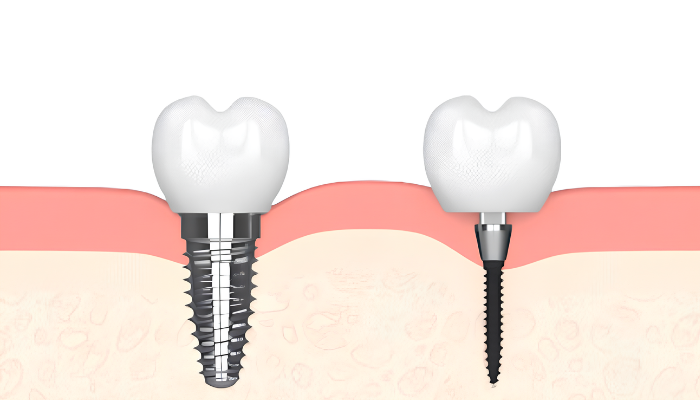
When deciding between a mini implant vs. a regular implant, there are a few factors to consider.
Structure
Regular conventional implants are typically around 5 millimeters in diameter and have multiple parts. The advantage of this size is that regular implants do a great job securing in softer bone, requiring a lot of bone structure for support. However, for those without sufficient bone, securing conventional implants is impossible without additional procedures such as a bone graft.
Mini dental implants are less than 3 millimeters in diameter and have a unique one-piece design. Thanks to their smaller structure, many patients with minimal bone are still eligible for dental implants, even without a bone graft! These implants secure in less bone and are simpler to place because of their one-piece design. Additionally, without multiple components, mini implants eliminate the seams between parts where bacteria can gather, helping safeguard against infection.
Procedure
Conventional dental implants require a surgical placement procedure over multiple appointments. After numbing your smile with a local anesthetic, we create an incision in your gums to reveal your jaw. Then, we use a series of drills to make a hole in your bone large enough to fit the implant body. With the screw in place, we stitch up your gums to facilitate healing. After your implant has had time to integrate with your jaw, we can place the abutment (or connector piece) on top to secure a temporary restoration!
Mini dental implants have a simpler procedure that doesn’t require any incisions or stitches. Instead, we create a small pilot hole through your gum and bone tissue, and gently secure the implant in place. Thanks to its sleek one-piece design, mini implants only need one placement procedure. Once inside your bone, these implants also immediately begin to secure. During the same appointment in which we place your implants, we can likely place a temporary crown, bridge, or denture, if not a final one.
Cost
Between the multiple components, appointments, and procedures, conventional implants are quite expensive. Fortunately, mini dental implants cost about half as much as traditional implants! With fewer appointments, fewer components, and fewer procedures necessary, patients can save money when restoring their smile with mini dental implants.
Mini Implant vs. Regular Implant: Which Is Best for You?
Dental implants are often the best tooth-replacement option after losing a tooth. But should you go with a regular implant or a mini implant? While both implants have their uses, mini dental implants far surpass conventional implants in benefits. Book a free consultation with us in Wayne, NJ, to learn which implant option is best for your smile!
Connect with Dr. Fine on Instagram and Facebook to explore the mini dental implant process.